Resources · Corporate
Serving a Business Entity in California
Registered agents, corporate officers, the Secretary of State fallback, and out-of-state entities — the full playbook for serving companies the right way.
Last updated: June 13, 2026
Start with the registered agent
Every California corporation, LLC, and qualified foreign entity must designate an agent for service of process. The agent's name and street address are published on the entity's Statement of Information at the Secretary of State's Business Search. That address is the front door.
Two flavors of registered agent show up:
- Individual agent — typically an officer, attorney, or insider, at a specific California street address.
- Commercial Registered Agent (CRA) — a company like CSC, CT Corporation, or Northwest, registered under Corporations Code § 1505.
Who else can accept service
CCP § 416.10 lists alternatives to the registered agent for corporations: the president or other head of the corporation, a vice president, secretary, assistant secretary, treasurer, general manager, or "a person authorized by the corporation to receive service of process." For LLCs, Corporations Code § 17701.16 adds managers (in manager-managed LLCs) and members (in member-managed LLCs).
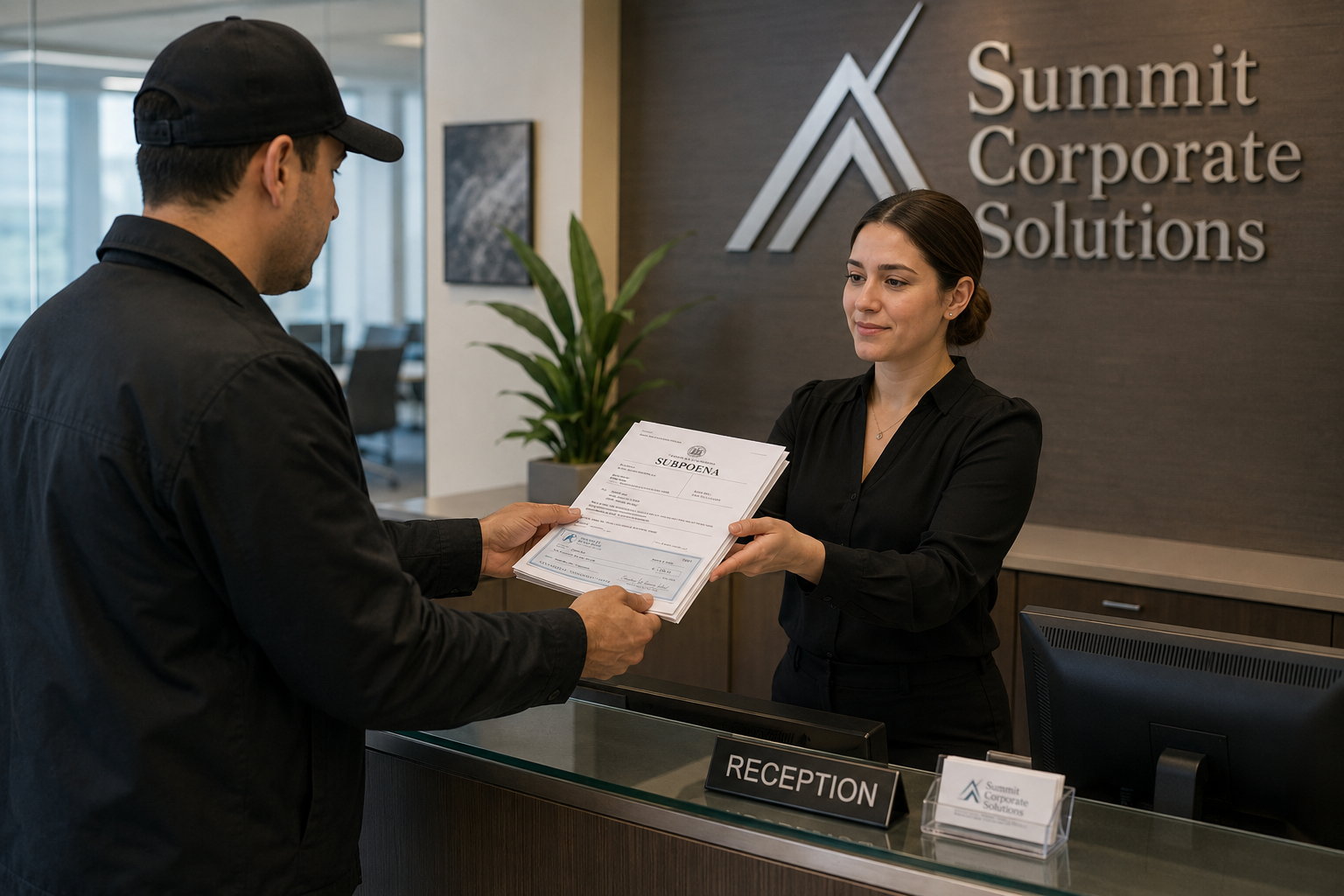
Practical tip: the in-house receptionist is not automatically a "person authorized." Hand-delivering to the receptionist works only if they're designated, or if you can show they routinely accept service on the entity's behalf.
When the agent can't be served
Registered agents move, retire, get fired, or duck service. California gives you a statutory escape hatch — but it has teeth.
Corporations: Corporations Code § 1702. If the agent cannot be served with "reasonable diligence" at the address on file, you can apply to the court for an order authorizing service on the corporation by hand-delivering process and a copy of the order to the Secretary of State.
LLCs: Corporations Code § 17701.16(d). Parallel structure for LLCs — court order, then deliver to the Secretary of State.
Either way, you'll need a declaration of diligence that shows real attempts at the registered address (see our due diligence guide) and a fee paid to the Secretary of State. Build in time — this isn't a same-week process.
Out-of-state and unregistered entities
If the entity is qualified to do business in California, it has a registered agent on file — serve them. If it's doing business in California without qualifying, your options open up:
- Long-arm jurisdiction under CCP § 410.10, combined with service at the entity's out-of-state principal office under CCP § 416.10
- Service under the entity's home-state rules (see our guide on out-of-state service)
- Hague Service Convention for international entities — significantly slower
Comparison: routes to serve a business
| Route | When to use | Speed |
|---|---|---|
| Registered agent | Default. Address on Statement of Information. | Same week, usually same day in LA |
| Corporate officer / LLC manager | Agent unreachable, or strategic reasons to serve up the chain | Days — depends on locating the officer |
| Secretary of State (§ 1702 / § 17701.16(d)) | Agent cannot be served despite diligent search | Weeks (motion + court order required) |
| Long-arm / out-of-state | Entity is doing business in CA without qualifying | Varies — depends on home state |
FAQ
Who can accept service for a California corporation?
Under Corporations Code § 1701 and CCP § 416.10, you can serve the corporation's designated agent for service of process, the president or other head of the entity, a vice president, secretary, assistant secretary, treasurer, general manager, or a person authorized to receive service.
What if the registered agent has moved or won't accept service?
If the agent cannot be found with reasonable diligence at the address on file, California Corporations Code § 1702 lets you serve the corporation by hand-delivering process to the Secretary of State (with a fee and a court order in many cases). This is a documented fallback, not a shortcut.
Can I serve an LLC the same way as a corporation?
Effectively yes. CCP § 416.10 also covers LLCs, and Corporations Code § 17701.16 lists who can accept service for an LLC: the registered agent, a manager, or a member if the LLC is member-managed. The Secretary of State fallback under § 17701.16(d) parallels the corporate version.
What about a foreign or unregistered entity doing business in California?
If the entity is qualified to do business here, it has a registered agent on file with the Secretary of State — start there. If it's doing business in California without qualifying, you can typically serve through Corporations Code provisions or the long-arm statute (CCP § 410.10), depending on the entity type.
How do I find a registered agent's address?
Use the California Secretary of State's free Business Search at bizfileonline.sos.ca.gov. The agent's name and California street address (P.O. boxes aren't allowed) appear on the entity's Statement of Information.
Need service handled right?