Resources · Litigation
How to Serve a Notice of Levy in California
A step-by-step guide for attorneys and paralegals enforcing a money judgment. Winning the judgment is only half the battle — collecting on it means serving the levy correctly.
Last updated: August 6, 2026
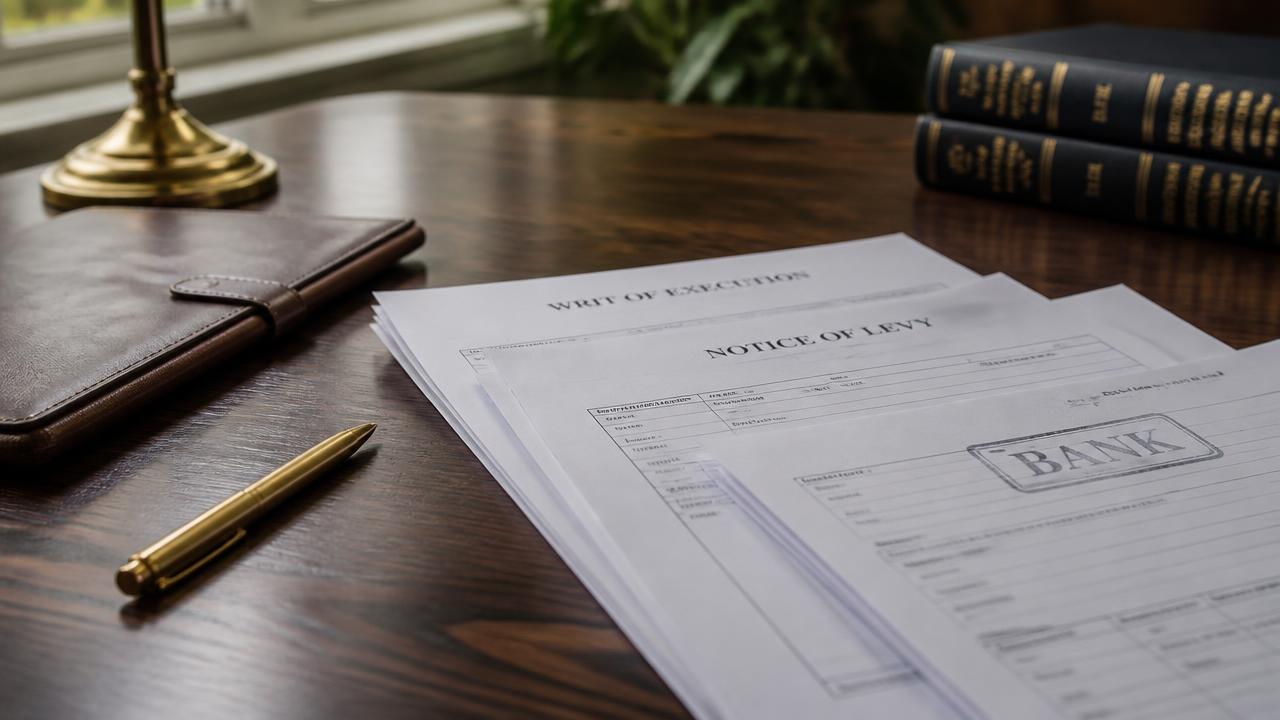
Winning a judgment is only half the battle. Collecting on it means enforcing the judgment against the debtor's property — and one of the most effective tools is the levy. When you levy on a debtor's bank account or other property held by a third party, the Notice of Levy is the document that makes it happen. But the levy is only as good as the service behind it. Serve it at the wrong location, miss a deadline, or botch the proof, and the levy can be rendered ineffective — sometimes after the funds have already moved.
This guide walks through how a Notice of Levy is served in California, the statutes that govern each step, and the mistakes that most often sink an otherwise valid levy. If you need a registered process server to handle the fieldwork, see our services page or contact us directly.
What a Notice of Levy actually is
A Notice of Levy (Judicial Council form EJ-150) is served under a Writ of Execution (form EJ-130) issued by the court after judgment. The writ directs the levying officer to enforce the judgment; the Notice of Levy is what's actually served on the person or institution holding the debtor's property — the garnishee — to seize it. The most common use is a bank levy on a judgment debtor's deposit accounts, but the same mechanics apply to other leviable property in a third party's hands.
Two roles matter throughout:
- The levying officer — the county sheriff (or, in federal cases, the U.S. Marshal). The levying officer remains responsible for the levy even when someone else performs the service.
- The person who performs the service — either the levying officer or, in many cases, a registered process server acting under Code of Civil Procedure § 699.080.
Who can serve a Notice of Levy
You have two paths. The levying officer can perform the levy directly, or a registered process server can perform it under CCP § 699.080, which is usually faster. When a registered process server handles the levy, the statute imposes specific requirements: the server must deposit a copy of the writ and the statutory fee with the levying officer before levying, and must return the writ and proof of service to the levying officer within five court days after service. Miss those requirements and the levy is ineffective — the levying officer isn't required to act, and can release the property.
Step 1 — Prepare the levy package
Before anyone goes out, assemble the documents the garnishee and the debtor are entitled to receive. For a typical bank levy that includes:
- A copy of the Writ of Execution
- The Notice of Levy (EJ-150) addressed to the garnishee
- A Memorandum of Garnishee (form AT-167/EJ-152) for the garnishee to complete
- The Exemptions from the Enforcement of Judgments list (form EJ-155)
Keep the debtor's copies separate from the garnishee's — they are served differently and at different times.
Step 2 — Serve the garnishee at the correct location
This is where more levies fail than anywhere else. Under CCP § 684.115, a financial institution with more than nine branches or offices in California must designate one or more central locations for service of legal process and register them with the Department of Financial Protection and Innovation (DFPI). If a bank has a designated central location, the levy must be served there — serving a branch is ineffective.
Before you serve, check the DFPI's published list of central locations. Do not assume the branch address on the paperwork, or the branch where the account was opened, is the right place to serve. Many large banks route all legal process to a single in-state processing center. If the institution has not designated a central location, then each branch is deemed a valid place for service.
For deposit-account levies, CCP § 700.140 governs how service on the financial institution is made. Serve a person authorized to accept legal process, and record the date, time, location, and the name and title of the person who accepts — you'll need it for your proof.
Step 3 — Serve copies, not originals
The garnishee receives copies. The original writ stays in the levying officer's chain and is returned to the levying officer with your proof. Never leave an original court-issued writ with a bank.
Step 4 — Complete the registered process server's proof
After service, complete the registered-process-server section of the Notice of Levy (check "delivered on," add the date, print your name, sign, and check the "registered process server" box) and prepare a separate Proof of Service identifying exactly what was served, on whom, where, and when, including the name and title of the person who accepted. Leave any section marked "for levying officer use only" blank — that belongs to the sheriff or marshal, not the server.
For a broader look at why service documentation matters, see our overview of what process serving actually is.
Step 5 — Serve or mail the judgment debtor
The debtor is entitled to notice, too. Under CCP § 700.010, at the time of levy or promptly thereafter, the debtor must be served with a copy of the writ and a Notice of Levy — served personally or by mail. Include the exemptions information (EJ-155) so the debtor knows their rights, and provide a claim-of-exemption form where appropriate.
Service by mail is governed by CCP § 684.120: first-class mail, postage prepaid, in a sealed envelope. Certified mail is not required. Address each debtor separately, even co-debtors at the same address. Then complete a Proof of Service by Mail, signed by the non-party who deposited it. Document the mailing date precisely — the debtor's window to claim an exemption (generally 15 days after personal delivery or 20 days after mailing) runs from it.
A key sequencing point: serve the garnishee first, confirm the levy was accepted, and only then serve or mail the debtor. Notifying the debtor of a levy that didn't actually take can create problems.
Step 6 — Return to the levying officer within five court days
Under CCP § 699.080, a registered process server must deliver the writ and proof of service to the levying officer within five court days after each levy. Note that the clock runs from the date of service on that garnishee — not from when the paperwork was first issued — and each garnishee has its own window. Include your Proof of Service, your Proof of Service by Mail to the debtor, and anything else the levying officer requires.
Step 7 — Let the garnishee respond to the levying officer
After service, the garnishee completes the Memorandum of Garnishee and returns it — along with any levied funds — directly to the levying officer, not to the server or the creditor. The garnishee generally has 10 days to respond. Failure to complete and return the memorandum can expose the garnishee to liability for the costs and fees of obtaining the information.
Common pitfalls to avoid
- Serving the wrong location. The single most common fatal error. Always check the DFPI central-location list before serving a financial institution.
- Missing the five-court-day return. The levy can be voided if the writ and proof aren't returned in time.
- Serving the debtor before the garnishee accepts, or forgetting the debtor notice entirely. Each is a separate, required step.
- Incomplete or unsigned proofs, or completing sections reserved for the levying officer.
- Treating one levy as covering everything. Each garnishee is a separate levy with its own notice, its own proof, and its own deadline.
When precision matters, use a specialist
A levy is unforgiving of small mistakes — a wrong address or a late return can undo the whole effort and let funds slip away. That's why many California firms hand their levies to a process server who does this every day.
Serving By Irving West handles bank levies and writ enforcement across California, including same-day and emergency service, correct central-location routing, and complete, court-ready proofs returned on time. New York hustle, California local expertise — persistence and precision on the hard-to-serve work. Reach us here or email info@servingbyirvingwest.com.
This article is for general informational purposes and is not legal advice. Statutes and court forms change; confirm current requirements and consult counsel for any specific matter.
FAQ
What is a Notice of Levy in California?
A Notice of Levy (Judicial Council form EJ-150) is served under a Writ of Execution (EJ-130) to instruct a third party holding the debtor's property — usually a bank — to turn it over. It is the document that actually triggers the seizure of leviable property.
Who can serve a Notice of Levy in California?
Either the levying officer (county sheriff or U.S. Marshal) or a registered process server acting under CCP § 699.080. A registered process server must deposit the writ and fee with the levying officer before serving, and return the writ and proof within five court days after service.
Where must a Notice of Levy be served on a bank?
Under CCP § 684.115, a financial institution with more than nine California branches must designate a central location for service of legal process and register it with the DFPI. The levy must be served at that central location — serving a branch is ineffective. If no central location is designated, any branch is valid.
Does the judgment debtor have to be notified of the levy?
Yes. Under CCP § 700.010, the debtor must be served with a copy of the writ and Notice of Levy at the time of levy or promptly thereafter, personally or by mail. Include the exemptions list (EJ-155) and a claim-of-exemption form where appropriate.
How long does a registered process server have to return the writ after a levy?
Five court days after service on each garnishee, under CCP § 699.080. The deadline runs from the date of service on that specific garnishee, not from when the writ was issued.
What are the most common mistakes that invalidate a California levy?
Serving the wrong bank location, missing the five-court-day return deadline, notifying the debtor before the garnishee accepts, forgetting the debtor notice entirely, completing sections reserved for the levying officer, or treating one levy as covering multiple garnishees.
Need service handled right?