Resources · Subpoenas
Subpoenas in California — Deposition, Trial, Records
Different subpoenas, different rules. Here's how to serve each kind so it actually compels the witness.
Last updated: June 13, 2026
Personal service is the default
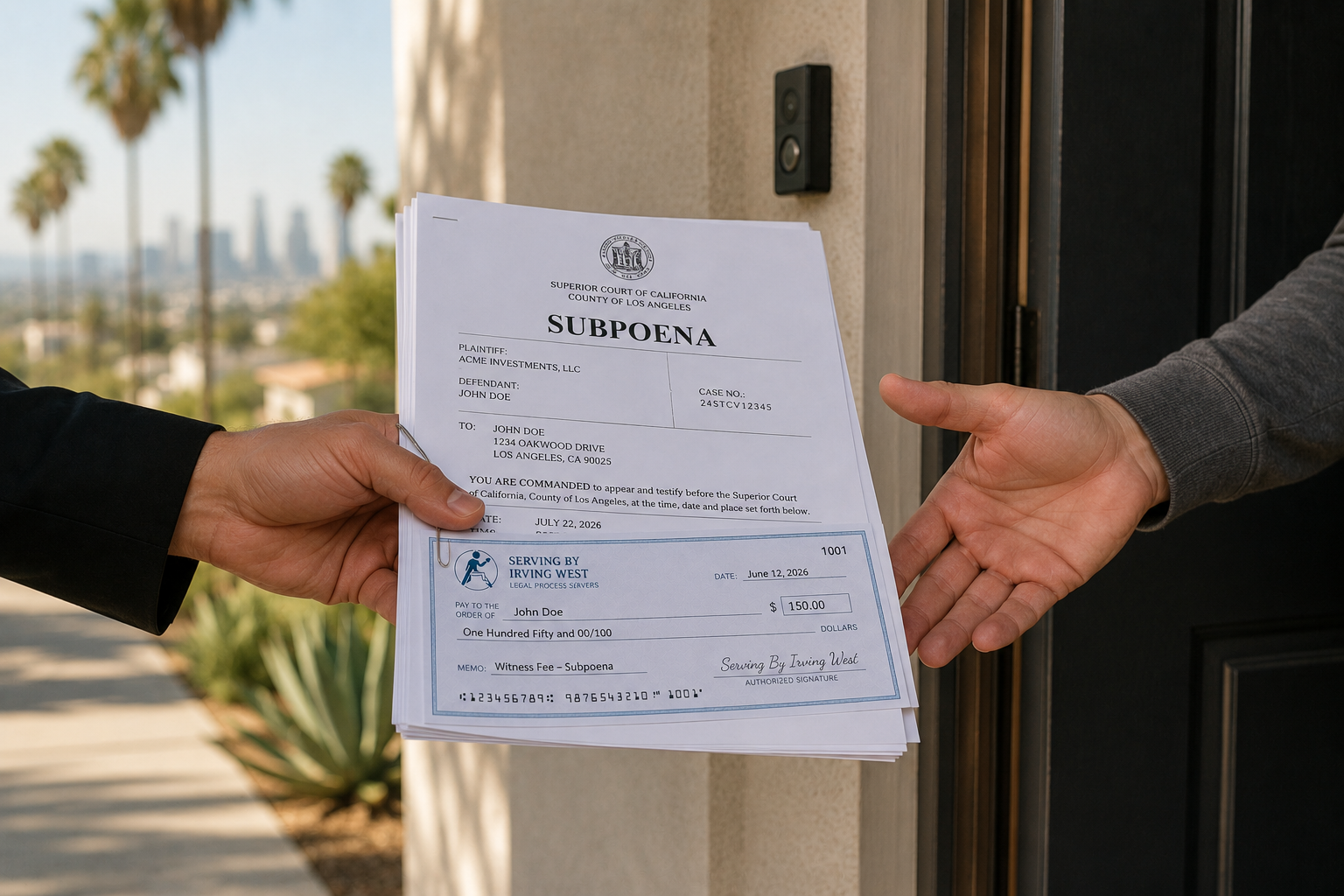
California Code of Civil Procedure § 1987 requires personal delivery of the subpoena to the witness. There are narrow exceptions (e.g. trial subpoenas on a party who has appeared, served on the party's attorney under § 1987(b)), but for the typical third-party witness, you serve them in person.
Deposition subpoena (personal appearance)
Used to compel a witness to appear and testify at a deposition. Key rules:
- Notice: at least 10 days before the deposition (CCP § 2025.270)
- Service: personal, on the witness
- Witness fee: $35/day + $0.20/mile each way, tendered at service if demanded (Gov. Code § 68093, CCP § 1986.5)
- Form: Judicial Council form SUBP-015 or equivalent
Deposition subpoena for production of business records
Used to obtain records from a third-party custodian (banks, employers, medical providers) without requiring a personal appearance. Key rules:
- Notice: minimum 20 days before production when a Notice to Consumer (CCP § 1985.3) or Notice to Employee (CCP § 1985.6) is required, and at least 15 days to give the consumer/employee time to object
- Notice to Consumer / Employee: must be personally served or mailed to the consumer or employee with proof of service before the custodian can produce
- Witness fee: governed by Evidence Code § 1563 — $15 cap for on-site inspection, or reasonable copying/clerical/postage costs for copies mailed in. See our full witness fees guide.
- Deposition officer: required under CCP § 2020.420 to receive, custody, and produce the records
- Form: SUBP-010
Trial subpoena
Used to compel a witness to appear and testify at trial. Key rules:
- Notice: no fixed statutory minimum, but the witness must have reasonable time to comply. Same-day service is technically allowed but practically unwise.
- Service: personal, with limited § 1987(b) exception for parties
- Witness fee: tendered at service if demanded ($35/day + mileage)
- Form: SUBP-001 (civil) or as the court directs
Quick comparison
| Type | Minimum notice | Fee required at service? | Service method |
|---|---|---|---|
| Deposition (appearance) | 10 days (CCP § 2025.270) | $35/day + mileage, if demanded | Personal |
| Deposition (records only) | 20 days w/ consumer/employee notice | $15 cap or reasonable costs (§ 1563) | Personal on custodian |
| Trial subpoena | Reasonable (no fixed minimum) | $35/day + mileage, if demanded | Personal (§ 1987(b) for parties) |
FAQ
Do California subpoenas require personal service?
Yes. CCP § 1987 requires personal delivery of the subpoena to the witness, with limited exceptions (e.g., service on a party's attorney for some trial subpoenas under § 1987(b)). Mail or substitute service is generally not valid for subpoenas.
How much notice is required for a deposition subpoena?
A California deposition subpoena for personal appearance generally requires at least 10 days' notice before the deposition date (CCP § 2025.270). A deposition subpoena for production of business records requires at least 20 days before the production date when a Notice to Consumer or Employee applies (CCP § 1985.3, § 1985.6).
What's the minimum notice for a trial subpoena?
There's no statutory minimum days for a California trial subpoena, but the witness must have a reasonable time to comply. Serving the morning of trial is technically allowed for nearby witnesses, but courts and witnesses both push back if there's no real opportunity to prepare.
When must the witness fee be tendered?
California Code of Civil Procedure § 1986.5 requires that the witness fee and mileage be tendered at the time of service if demanded by the witness. Best practice is to tender at service regardless. See our companion guide on witness fees for the exact amounts.
What's a deposition officer?
For records-only subpoenas, the deposition officer is the neutral person (often the deposition reporting service or a registered photocopier) who receives the records, maintains custody, and produces them to the requesting party. CCP § 2020.420 sets the requirements.
Need service handled right?